Observe the dimensions indicated by the manufacturer
This is the very first criterion to consider when choosing tyres for your car.
As a tyre does not have a standard size, you must first identify the tyre sizes that are compatible with your vehicle before making your choice according to the other criteria that we will explain below.
Where can I find the tyre sizes for my car?
Look at the sidewall of any one of your tyres and note the numbers and letters on it.
This information will help you find the tyres that fit your car.
Here is an example of the complete dimensions of a tyre: 255/55 R17 72H
You can also find the tyre sizes in your driver or passenger door
Tyre sizes are also listed in your vehicle's owner's manual (which you should find in the glove compartment). These documents usually contain all the information relating to your tyre size and specifications, as well as the appropriate tyre pressure.
What do these letters and numbers mean?
Tyre Width or Section Width : (Example : 255)
Tyre width in millimetres is measured from the widest point of a tyre’s outer sidewall to the widest point of its inner sidewall.
Aspect Ratio : (Example : 55)
Aspect ratio is the relationship between a tyre’s sidewall height and the tyre's width. The lower the ratio, the smaller the sidewall height, which means better cornering but a rougher ride.
Construction : (Example : R)
This indicates the tyre’s internal construction. They can be R (Radial) like most tyres, or D (Diagonal construction) or B (Belted).
Wheel Diameter : (Example : 17)
The number is in inches and indicates the diameter of the wheel on which the tyre is designed to fit.
Load Index : (Example : 72)
This indicates how much weight the tyre is certified to carry at maximum safe inflation. The numbers refer to a chart that specify the load capacity that the tyre can carry.
For example, 72 = 355 kg.
You can find yours in the load Index chart :
Load Index | Maximum Load (kg) | Maximum Load (Lbs) |
71 | 345 kg | 761 lbs |
72 | 355 kg | 783 lbs |
73 | 365 kg | 805 lbs |
74 | 375 kg | 827 lbs |
75 | 387 kg | 853 lbs |
76 | 400 kg | 882 lbs |
77 | 412 kg | 908 lbs |
78 | 425 kg | 937 lbs |
79 | 437 kg | 963 lbs |
80 | 450 kg | 992 lbs |
81 | 462 kg | 1019 lbs |
82 | 475 kg | 1047 lbs |
83 | 487 kg | 1074 lbs |
84 | 500 kg | 1102 lbs |
85 | 515 kg | 1135 lbs |
86 | 530 kg | 1168 lbs |
87 | 545 kg | 1201 lbs |
88 | 560 kg | 1235 lbs |
89 | 580 kg | 1279 lbs |
90 | 600 kg | 1323 lbs |
91 | 615 kg | 1356 lbs |
92 | 630 kg | 1389 lbs |
93 | 650 kg | 1433 lbs |
94 | 670 kg | 1477 lbs |
95 | 690 kg | 1521 lbs |
96 | 710 kg | 1565 lbs |
97 | 730 kg | 1609 lbs |
98 | 750 kg | 1653 lbs |
99 | 775 kg | 1709 lbs |
100 | 800 kg | 1764 lbs |
101 | 825 kg | 1819 lbs |
102 | 850 kg | 1874 lbs |
103 | 875 kg | 1929 lbs |
104 | 900 kg | 1984 lbs |
Speed Rating chart : (Example : H)
This indicates the maximum safe speed at which a tyre is certified to carry a load under specified conditions. Speed ratings range from A (lowest) to Y (highest), with one exception: H falls between U and V.
For example, H = 210 km/h.
To find the maximum speed for your tyre, refer to the speed rating chart. Exceeding the lawful speed limit is neither recommended nor endorsed.
Speed Index | Maximum speed (km/h) | Maximum speed (mph) | Tyre types / Vehicle type |
L | 120 km/h | 75 mph | Off-Road & Light Truck tyres |
M | 130 km/h | 81 mph | Temporary spare tyre |
N | 140 km/h | 87 mph | Temporary spare tyres |
Q | 160 km/h | 99 mph | Winter 4x4 |
R | 170 km/h | 106 mph | Heavy Duty Light Truck |
S | 180 km/h | 112 mph | Family Sedans & Vans |
T | 190 km/h | 118 mph | Family Sedans & Vans |
U | 200 km/h | 124 mph | Sedans & Coupes |
H | 210 km/h | 130 mph | Sport Sedans & Coupes |
V | 240 km/h | 149 mph | Sport Cars |
W | 270 km/h | 168 mph | Exotic Sport Cars |
Y | 300 km/h | 186 mph | Exotic Sport Cars |
High load Capacity tyres (HL tyres)
HL tyres are designed to support the weight of Electric & Hybrid vehicles. They allow the use of the same tyre size but with higher load carrying capacity.
You can recognise a HL tyre by the HL prefix located at the beginning of the tyre size markings
What are OE tyres?
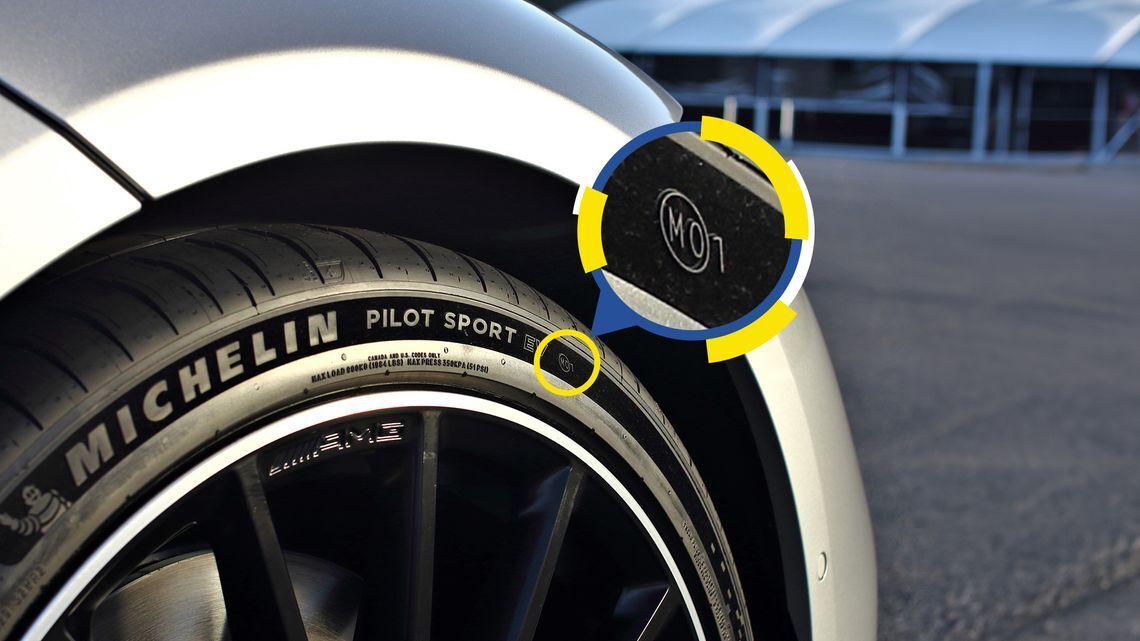
OE stands for “Original Equipment”, meaning that the tyres were approved by your vehicle manufacturer to be fitted as standard on your vehicle.
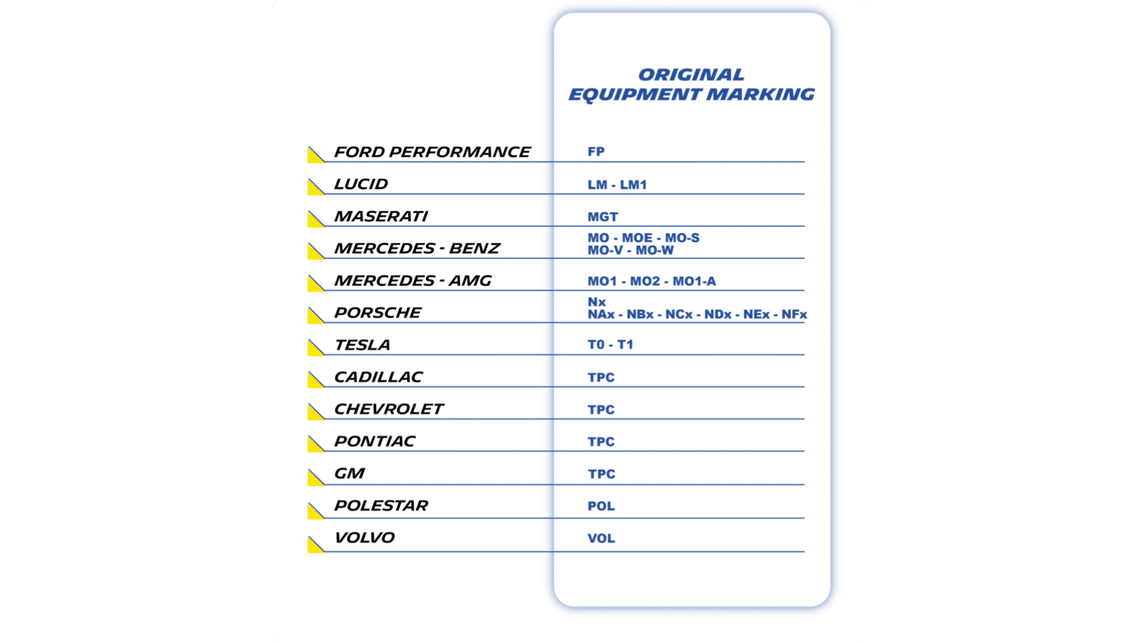
Some vehicle manufacturers, such as Audi, BMW, Mercedes and others, equip their vehicles with tyres that are specifically designed for their brand. These tyres have a special OE marking on the sidewall. In this case, MICHELIN recommends replacing the tyres on your vehicle with tyres with the specific OE marking.
Table of OE markings by vehicle brand:

Choosing tyres for my car according to my use and the conditions of use
Once you have the dimensions, there are three other criteria to consider:
the climatic conditions in which you drive
your driving style
the type of vehicle (electric or thermic)
Climatic conditions :
The other criterion we recommend you take into account when choosing tyres for your car is the weather conditions.
How do I choose tyres for my car according to the climate?
Opt for summer and winter tyres if you drive in a mountainous region exposed to severe winter conditions (snow, winter, ice) for several months of the year and temperatures below 7°. If your winter conditions are more severe, see our article "How to choose a winter tyre?"

- Opt for all-season tyres if you live in a region with less severe winters with occasional snowfall.
- Opt for summer tyres all year round if you drive in southern European regions with mild winters (temperature over 7°C, no snow).
Your driving style :
To make sure that you enjoy your drive, look for tyres that match the way you like to drive.
If you like a quiet comfortable ride :
Look for tyres that specifically mention comfort, smooth ride, or low road noise. Generally speaking, touring tyres with lower speed rating (S, T or H ratings on the sidewall) are optimized for more comfort instead of more speed – it's recommended to never fit a tyre with the speed rating lower than the one specified by the manufacturer of your vehicle. Also, avoid aggressive tread designs – they may look cool but can generate lots of road noise.
Our MICHELIN Primacy 4⁺, for example, would be a good choice.
If you like to feel every curve :
Look for tyres that mention great handling or steering precision. These are often called high-performance tyres and have higher speed ratings, meaning that they are optimized to provide better control and a stiffer, more precise ride.
Our MICHELIN Pilot Sport ⁵, for example, is suitable for this style of driving.
The type of vehicle (electric or thermic)
More and more electrically powered vehicles are being introduced to the market. Specific tyres are now offered because they are designed for the particular characteristics of these vehicles. Tyres with low rolling resistance, for example, are suited to maximise battery range. This applies to our MICHELIN e·Primacy and MICHELIN Pilot Sport EV tyres.
Although the MICHELIN e·Primacy is not specifically designed for electric vehicles, it is particularly well suited to them because of its ability to offer low rolling resistance. The MICHELIN Pilot Sport EV is more suitable for "sporty" electric vehicles (e.g. Porsche Taycan, Tesla Model Y, etc.)
TYRE RANGES | FOR WHICH VEHICLES ? | RECOMMENDED FOR |
MICHELIN Primacy ⁴ ⁺ | VW Golf 8, BMW Serie2, Renault Scenic, Peugeot 3008, DS3 CrossBack | Thermic |
MICHELIN e·Primacy | VW Golf 8/e.Golf, Peugeot 3008/3008 Hybrid, Renault Zoe, DS5 Hybrib | Thermic & Electric |
MICHELIN Pilot Sport ⁵ | AUDI A4, MERCEDES C, BMW X3-X5 AMG GLE | Thermic |
MICHELIN Pilot Sport EV | TESLA Model Y, AMG EQS, VOLVO XC 40BEV | Electric |
MICHELIN Pilot Sport ⁴ ˢ | BMM M3, PORSCHE 911(II), AMG CLS53 | Thermic & Electric |
MICHELIN CrossClimate² | VW Golf 8, Peugeot 3008, Renault Kadjar, Volvo XC40, Audi Q3 | Thermic & Electric |
Choosing tyres for my car using the European tyre label
To help you choose the best tyres for your car, you can also use the labelling system set up by the European authorities, which allows you to highlight certain tyre performances, in particular wet grip and energy efficiency, with a grade ranging from A to E. See our article on the European tyre label :
A tool to help you choose the best tyres for your car
This tool will help you to choose the best suitable tyres from the main MICHELIN offers available, according to the seasonal criteria mentioned above.
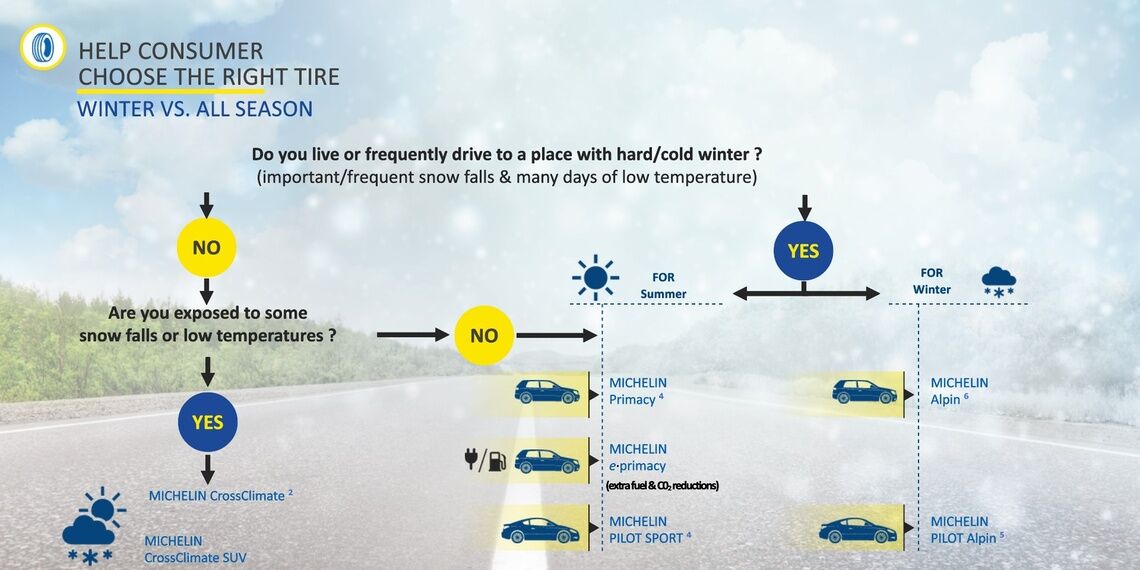
For example, if you have a family car such as a Renault Scenic and drive in a mountainous region, you will be alternating summer and winter tyres.
In this case, you can choose MICHELIN Alpin ⁶ for winter and MICHELIN Primacy ⁴ for summer.
Addressing key questions
FAQ about choosing the best tyres for my car
Examine your tyres for visible damage, including cuts, cracks, or sidewall bulges, which compromise structural integrity. Remember that tyres naturally degrade over time, so it’s recommended that you replace them after 10 years, regardless of appearance, as rubber compounds can deteriorate even with minimal use.
Always verify your vehicle's specifications, including size, speed rating, and load index, to ensure the tyres you choose are compatible and provide optimal performance.
See other related articles
-
MICHELIN-developed marked tyres
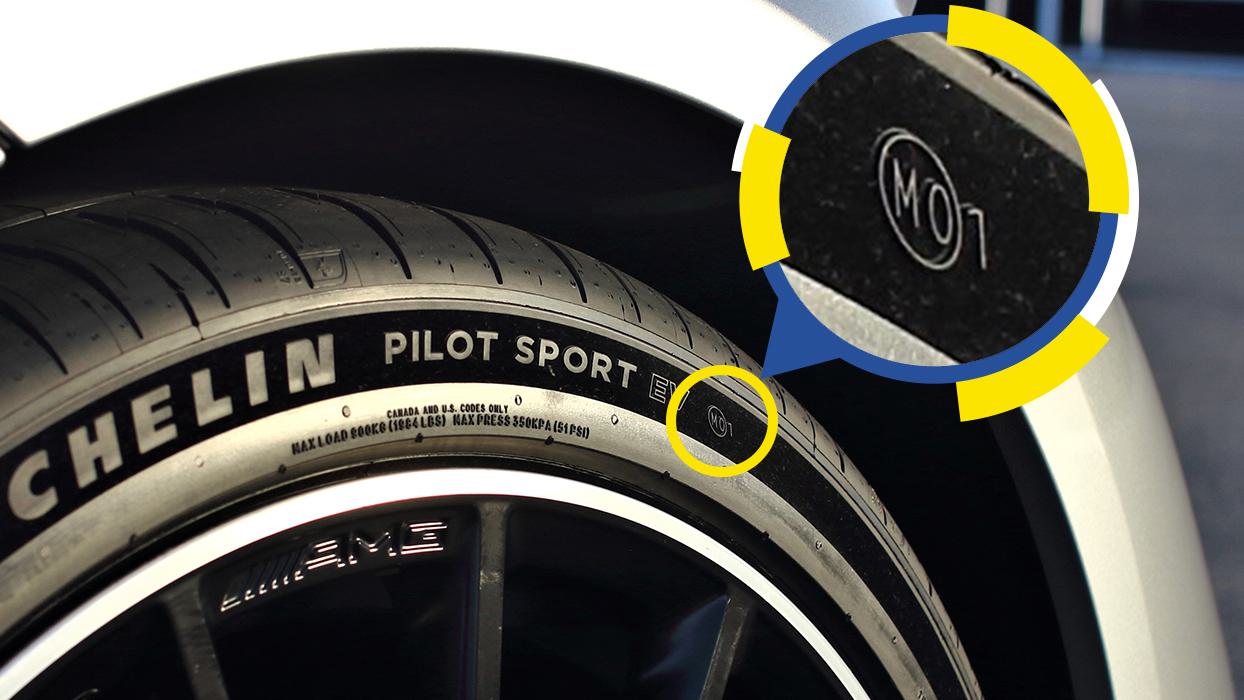
Michelin believes that working closely with car manufacturers is essential when it comes to developing high-performance tyres. Its engineers use their expertise to select the best technologies and materials as a function of the individual characteristics of each car model, thereby ensuring superior performance and ride comfort, and a truly unique driving experience!View more -

How to prepare your visit to the tyre shop nearby?
Before going to the tyre shop nearby, that you can easily find with our dealer locator, we recommend that you follow these few preparation steps. Why? Because the more prepared you are, the better you will be guided in choosing the right tyres for your driving needs.View more -

What is rolling resistance?
Rolling resistance (RR) has a significant impact on the energy a vehicle needs to move. Hence a direct link with fuel consumption for combustion-powered cars - around 20% - or battery range for electric vehicles. Tyre design can help reduce rolling resistance.View more